

The hardest part of back-to-school is rarely the first day. It is the two weeks on either side of it.
Most families already know the basics: build a visual schedule, read a social story, visit the building. Those things work. What follows assumes you have heard that advice and are looking for the next layer, the specific steps that tend to get skipped and then cause trouble in September.
This guide is organized by when to do things, not by who does them.
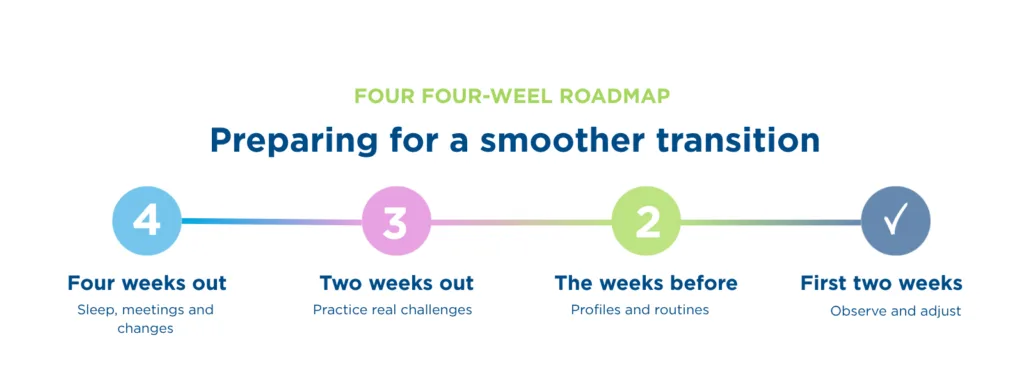
Four weeks out
- Shift sleep in small increments. If your child’s summer wake time is two hours later than the school-year wake time, moving it all at once will not hold. Shift by 15 minutes every third day. Four weeks gives you enough runway to close a two-hour gap without a fight.
- Request the IEP or 504 meeting now. Schools schedule these in the order requests come in, and the first three weeks of the year fill up fast. Put the request in writing by email so there is a date stamp. If your child is transitioning from ABA services into a school setting for the first time, ask specifically whether the team has reviewed the most recent progress data.
- Ask what changed. New building, new classroom, new bus route, new aide, new lunch period. Get the list early. Every item on it is something you can practice.
Two weeks out
- Practice the parts that are actually hard. Walking the hallway is easy. The cafeteria at full volume is not. Neither is a fire drill, a bathroom with an automatic flush, or a locker that sticks. If the school will let you in during a quieter week, spend your visit on the difficult spaces rather than the pretty ones. Ask the front office when the first fire drill is scheduled and whether staff can give your child a heads-up.
- Do a full lunch rehearsal. Pack the real lunchbox with the real containers and let your child open every one of them without help. Yogurt tubes, juice pouches, and snap-lid containers defeat a lot of kids on day one, and a child who cannot open lunch may not ask for the help they need.
- Get the AAC device school-ready. Charge it, check the mount or case, and load school vocabulary before the first day: teacher names, classroom, bathroom, bus, lunch, help, break, all done, I need a minute. Build a low-tech backup board and send it in the bag. Devices get left at home, run out of battery, and go in for repairs, and a child without a voice for a day is a child having a hard day.
- Wear the clothes. New shoes, new backpack, and stiff uniform fabric are sensory events. Break them in at home for short stretches now.
The week before
Write the one-page profile. Not a packet. One page, and keep it to these five sections:
- What works. Two or three strategies that reliably help, written as instructions a substitute teacher could follow.
- What sets things off. If possible, be specific. “Loud noises” is less useful than “hand dryers and the intercom.”
- How my child communicates. Device, signs, PECS, speech, or a mix.
- What escalation looks like early. The quiet signals before the loud ones. This is the most valuable thing on the page to help your child get assistance to regulate before it escalates.
- Who to call. You, another trusted adult, and/or, with your consent, your child’s BCBA.
Lock the goodbye script. Pick the exact words and the exact sequence for drop-off and use them every single morning. Same phrase, same length, same exit. Lingering at the door because the goodbye is going badly teaches your child that the goodbye is negotiable.
Practice the drop-off itself, not just the drive. Park, walk to the door, say the script, and shut the car door. Try the reverse order for the pick-up routine.
The first day, and the two weeks after it
- Plan a low-demand afternoon. No errands, no appointments, no new activities. Hold the first week clear if you can.
- Expect it to get worse before it gets better. Many children hold it together all day at school and fall apart at home. This is common; it is not a sign that school is failing, and it is not misbehavior. Give the first hour after pickup to decompression: no questions about the day, no homework, no demands. Set up a quiet corner like we have in our ABA centers.
- Watch for regression in skills you thought were solid. Toileting, sleep, and eating often slip during a big transition and usually recover within a few weeks. Track what you see rather than trusting memory.
- Check in on day 3 and day 10. Day 3 catches the things from your child’s teachers nobody anticipated. Day 10 tells you what is actually going to hold. Two short, specific emails beat one long meeting in October.
- Loop in your BCBA early. If your child receives ABA services, share what you are seeing at home in the first two weeks. Adjustments made in September are far easier than corrections made in November.
For teachers in the first two weeks
- Pair before you demand. Spend the early days becoming associated with good things before becoming the person who assigns work. Compliance follows the relationship, not the other way around.
- Honor the communication method every time. If a child requests a break using a device, sign, or card, grant it early on even when the timing is inconvenient. A request that gets ignored teaches the child to escalate to something that will not be.
- Read the early signals. If the parent profile lists them, it can be quicker to respond at the first sign than waiting until escalation. Autistic children process the world differently and may need a different support method from their peers. Say what to do, not what to stop. “Feet on the floor” gives a child something to succeed at. “Stop kicking” does not.
Give a cue before every transition, and use the same cue each time. Start with “Listening ears! We’re off to the library,” or “Ready Class! It’s lunch time!” These also let the entire class know what’s next in the schedule.
Community resources near our centers
Local events are a low-pressure way to pick up supplies, meet school staff, and connect with other families before the year begins.
- Utah County, UT: Mountainland Community Health Fair, August 6 Health screenings and family resources ahead of the school year.
- Charlotte, NC: KidsStreet Back-to-School Bash, August 15 Free supplies and family activities. Registration through allevents.in.
- Greenville, SC: Disability Resource Expo, August 23 The most relevant event on this list for our families. Vendors, service providers, and school resources in one place, built specifically around disability support. Details at bridgedsc.org/expo.
- Riverside County, CA: First 5 Riverside Back to School 2026, September 29 Geared toward families with young children, and useful for anyone whose transition questions carry past the first month. Tickets through Eventbrite.
Ongoing and multi-date events
- Cabarrus and Rowan County, NC: Cabarrus Rowan Community Health Centers is hosting several back-to-school events across the area on rotating dates.
- Nashville, TN: Metro Nashville Public Schools is running back-to-school bashes with free school supplies at multiple locations.
- Columbia and Rock Hill, SC: Richland County Recreation and local partners host several community bashes through early August.
This is the next milestone for your child. As a trusted partner, we’re here to help you celebrate every WOW moment along the way.
About ABS Kids: ABS Kids partners with children and families to deliver high-quality, compassionate applied behavior analysis (ABA) therapy at home, in schools, and in our centers. From diagnosis to ongoing treatment, we support children with autism every step of the way. We proudly provide ABA therapy in California, North Carolina, South Carolina, Tennessee, and Utah. Join our team to combine purpose with professional growth.

