

If you are reading this in our waiting room, you may be in the middle of a long process. A diagnosis. A waitlist. A new schedule and a lot of new words. Wherever you are in it, you are not alone.
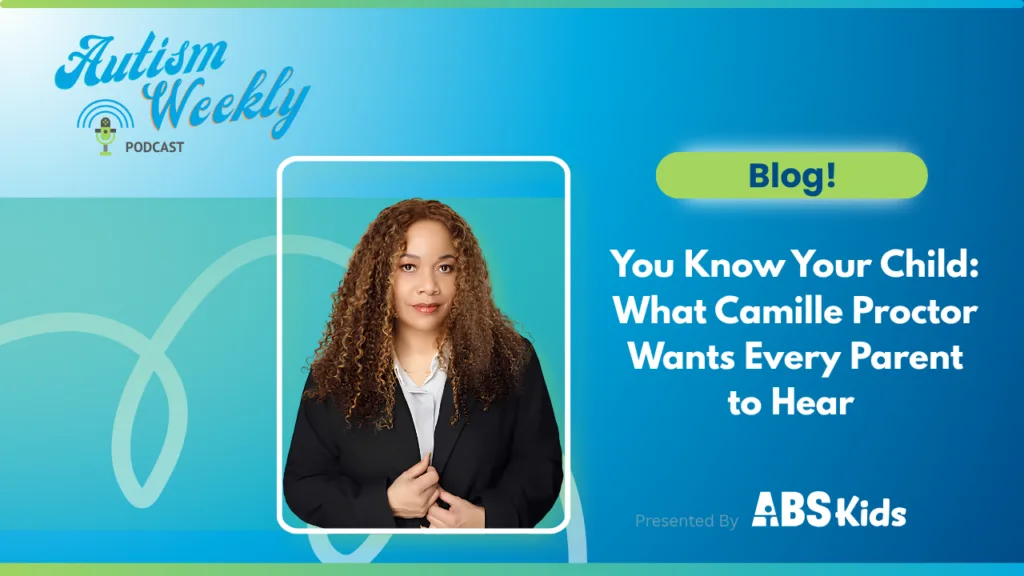
On this week’s episode of Autism Weekly, host Jeff Skibitsky talks with Camille Proctor, founder and executive director of the Color of Autism Foundation. Camille started the organization in 2009 after her son was diagnosed. Since then, she has built a national resource for Black families navigating diagnoses and services. She was appointed to the Michigan State Disability Council by Governor Whitmer and co-authored research on culturally grounded parent training with Black parents.
Her message to families is simple: an informed parent is an empowered parent.
What Camille Shared
She was dismissed before she was heard
Camille knew early that something was different. Her son was not using words or pointing, and he was drawn to fans and spinning wheels. She kept hearing “boys are slow” and “he makes eye contact, so it’s not autism.” No one noticed he only made eye contact with women.
The diagnosis took a long time. When it finally came, relief did not follow. “Where do I go and what do I do?” she remembers thinking.
She did not see herself in the room
At support groups, no one looked like her. When she asked what might happen if police approached her non-speaking son, other parents told her not to worry. “My son’s reality is different from your son’s reality,” she told them. Eventually, she was asked not to come back.
A year after her son’s diagnosis, she started the Color of Autism Foundation. She saw families avoiding diagnosis because autism had never been shown to them in a way that looked like their child. Some children were labeled with oppositional defiant disorder (ODD) instead, a label that does not open the door to the right support.
The wait is real, and you can use it
In Michigan, Camille explained, a family may get a diagnosis from a pediatrician but still need a separate referral before services can begin. A child diagnosed in the fall might not be evaluated until spring and might not start services until late summer.
That gap is why her team built free, five-week parent trainings. “We want the parents to do something rather than do nothing at all,” she said. One parent told her that by the time ABA therapy started, she already knew how to write a behavior plan.
Parents are the navigator
Camille’s advice to providers is direct: ask, do not assume. What does a typical day look like in your home? What goals matter to your family?
“The parent is actually steering the boat,” she said. “You’re like a co-captain.”
She also named something many families feel. Parents of color often tell her someone spoke to them in a condescending way. No parent should have to prove they are smart enough to understand their own child.
Autistic people are not one thing
Autistic trainers lead parts of the Color of Autism curriculum, including Natasha Nelson, an Army veteran who was diagnosed after her children were. Camille wants families to meet autistic adults because “autistic people are not one thing. They’re a plethora of things, just like we all are.”
She also rejects functioning labels. Someone who can “do all the things” but cannot rest or connect with others is not “high functioning.” She does not call herself an autism mom. “I’m an ally to a community that I want to help be included by design.”
8 Tips to Take With You
- Trust what you see. You are with your child every day. If something feels off and you are told to “wait and see,” you can ask your insurance for another provider. Look for someone who listens and says, “Let’s find out.”
- Write it down in plain words. You do not need clinical terms. Note what happened before, what your child did, and what happened after. One parent noticed her daughter took off her clothes every time she wore jeans. The seams bothered her. A dress solved it.
- Remember that behavior is communication. Your child is telling you something. As Camille put it, “It’s really not them, it’s us. We don’t know what’s going on.”
- Bring a list to every appointment. Write your questions and observations before each visit, including your first ABA therapy intake. It keeps the conversation focused on what matters to you.
- Use the waiting time to learn. Read about speech therapy, occupational therapy, and ABA therapy so you know what to expect. Progress takes time. Keep talking with your child, even if they do not answer in words.
- Ask your child, too. Communication is not only speaking. Offer choices and notice what your child tells you, through words, gestures, or actions. If a certain activity is too loud, that is information. Noise-canceling headphones or chewable jewelry can meet a real need.
- Tell your team who your family is. Share your culture, your faith, your routines, and your goals. If your household has expectations, like who can enter your home, say so early. A good team will build around them.
- Plan for hard moments. Write down what calms your child and what does not, so caregivers and first responders have it ready. If your child wanders, work with your team to understand why, not just how to lock a door.
Advocating for your child does not make you “too much.” It makes you part of the team. At our ABA therapy centers, your child’s team wants to hear what you notice at home. Bring your notes. Ask your questions. You know your child best.
To Autistic Readers
If you are autistic and reading this, this conversation is about you too. You are not a problem to solve. Autistic people have always been here, and you are not one thing. Your way of communicating counts, whether or not it uses words. Your voice belongs in every decision about your life.
Listen and Find Support
Hear the full conversation on this week’s episode of Autism Weekly:
To learn more about the Color of Autism Foundation, visit colorofautism.org. You will find:
A general parent support group and a dad support group
Free five-week parent trainings
As Camille said, “Everyone has a question, including me some days.” Wherever you are on this journey, there is support for you.

