
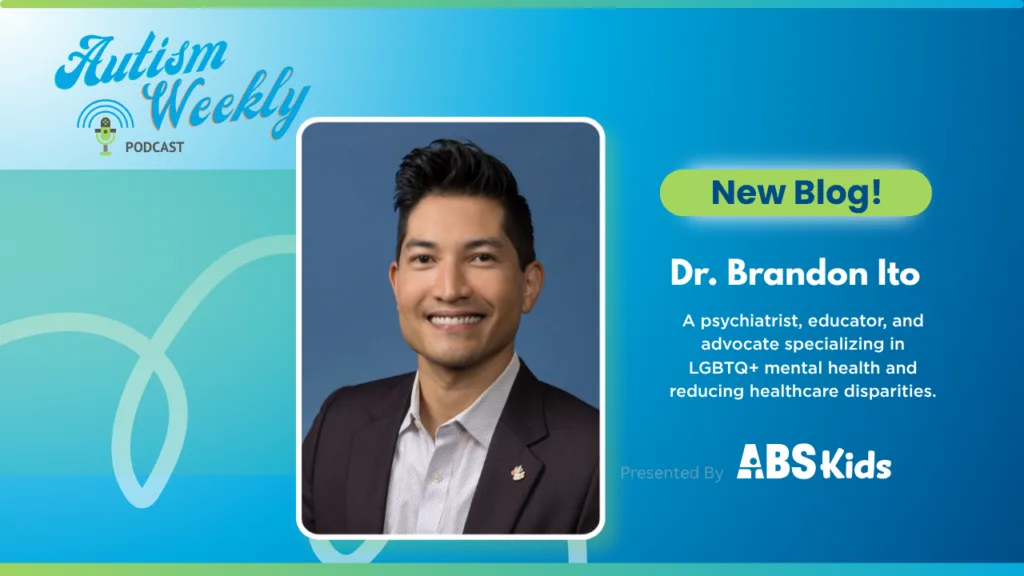
Dr. Brandon Ito, MD, MPH, psychiatrist, educator, and LGBTQIA+ health advocate
If your child is autistic and has also started exploring questions about their gender or sexual identity, you are not alone. And you are not in uncharted territory, even if it feels that way.
This is a conversation that is long overdue in both the autism community and in healthcare. Dr. Brandon Ito, a psychiatrist at UCLA who specializes in LGBTQIA+ mental health and neurodevelopmental care, joined the Autism Weekly Podcast to talk through what families need to know, how research is helping to define care, , and what good support looks like at this intersection.
Here is what he shared.
These two communities overlap more than most people realize.
Statistically, if you have two rare things, the odds of them occurring together should be extremely small. But that is not what the research shows. Between 1 and 12 percent of autistic individuals also experience gender diversity, and similar numbers show up in gender clinics. That is far too high to be a coincidence.
Dr. Ito offered one explanation that resonated: many autistic individuals simply do not follow social rules that do not make sense to them. Gender norms are, in many ways, arbitrary. When you step back and ask why certain gender expectations exist, the answer is often unclear. For some autistic people, that questioning is natural, not a symptom.
The mental health stakes are real.
Both autistic individuals and LGBTQIA+ individuals face elevated rates of depression, anxiety, and other mental health challenges. When someone holds both identities, those risks can compound.
Dr. Ito was direct about why: it is not primarily about biology, it is about minority stress. The chronic experience of stigma, discrimination, and the exhausting work of figuring out which version of yourself is safe to show in which environment takes a real toll.
He described it plainly: if you are masking your neurodiversity at school, at work, and among friends, and at the same time concealing your gender or sexual identity, your brain never gets to rest. Add in racial, ethnic, or religious identities on top of that, and the weight becomes significant.
Masking happens in both communities.
Parents of autistic children are familiar with masking. It is the work of suppressing behaviors or traits to fit into social expectations, often at a cost to the person doing it. The same dynamic plays out for LGBTQIA+ youth who do not feel safe being fully themselves.
The more someone has to mask, the less energy they have for self-advocacy, community building, and the kind of connection that actually supports mental health.
Family support changes everything.
This was perhaps the most important thing Dr. Ito shared, and it is worth reading twice.
When LGBTQIA+ youth come from accepting families, their risk of attempting suicide goes down by more than eight times. Of children from supportive families, 92 percent believe they can grow up to be happy adults.
Families do not have to have all the answers. They do not have to understand everything right away. What matters most is that the child feels loved and accepted as a whole person.
Dr. Ito said that when he sits down with families who are struggling with what to do, he asks one question: what do you want for your child’s future? Almost every time, the answer is the same. They want their child to be happy, healthy, and loved. From there, the conversation can move forward, because affirming a child’s identity and wanting those things for them are not in conflict.
What families sometimes get wrong, and how to course correct.
One of the most common tensions Dr. Ito sees is when a parent comes in focused on autism-related support, and the child actually wants to talk about their gender identity. The child may already have a handle on the autism piece. What feels most urgent to them is something different.
He also addressed the concern that some parents carry quietly: is this a phase? Is my child confused because of their autism? His response was measured and clear. Cognitive ability does not determine gender identity. Autistic children who are fully verbal and cognitively capable are still fully capable of knowing who they are. The question worth sitting with is not whether to believe the child, but how to take the next small affirming step.
What the field still needs to do.
Dr. Ito was candid about the gaps. Medical training has historically treated LGBTQIA+ health as a narrow topic, tied primarily to sexual health and STI prevention. The broader picture of identity, mental health, and affirming care has not always been part of the curriculum.
Providers often ask less, counsel less, and educate less on these topics when working with autistic youth. That needs to change. Autistic young people who identify as gender diverse have shared that one of their biggest fears is not being listened to or being dismissed because of their autism. That fear is not unfounded.
Dr. Ito’s call to providers was simple: ask, listen, and advocate. Not all advocacy looks like activism. Sometimes it looks like using someone’s preferred name. Sometimes it looks like educating yourself so you can be a more informed resource for the family in front of you.
A note on the current moment.
Being a kid right now is hard. Being an LGBTQIA+ kid is harder. Being an autistic LGBTQIA+ kid can feel like navigating a world that was not designed with you in mind.
Half of transgender youth in the United States currently live in states with laws or policies that restrict their participation in sports, bathroom access, or access to gender-affirming medical care. Resources that previously existed for these young people have been reduced. The environment is heavy.
That does not mean families are powerless. It means the support that happens at home, in the clinic, and in the community matters more than ever.
What you can do right now.
You do not need to be an expert. You do not need to have every answer. What research consistently shows is that presence, acceptance, and a willingness to listen are the most protective things a family can offer.
If your child brings something up, hear them out. If you have questions, ask them. If you want to learn more, the Autism Weekly Podcast episode with Dr. Brandon Ito is a good place to start.
The full episode is available on all major platforms. Search Autism Weekly wherever you listen to podcasts.
Dr. Brandon Ito, MD, MPH is a psychiatrist, educator, and advocate at UCLA Health specializing in LGBTQIA+ mental health and reducing healthcare disparities. He serves as a UCLA Health LGBTQIA+ Champion and is actively involved in training the next generation of clinicians to provide affirming, whole-person care.

