
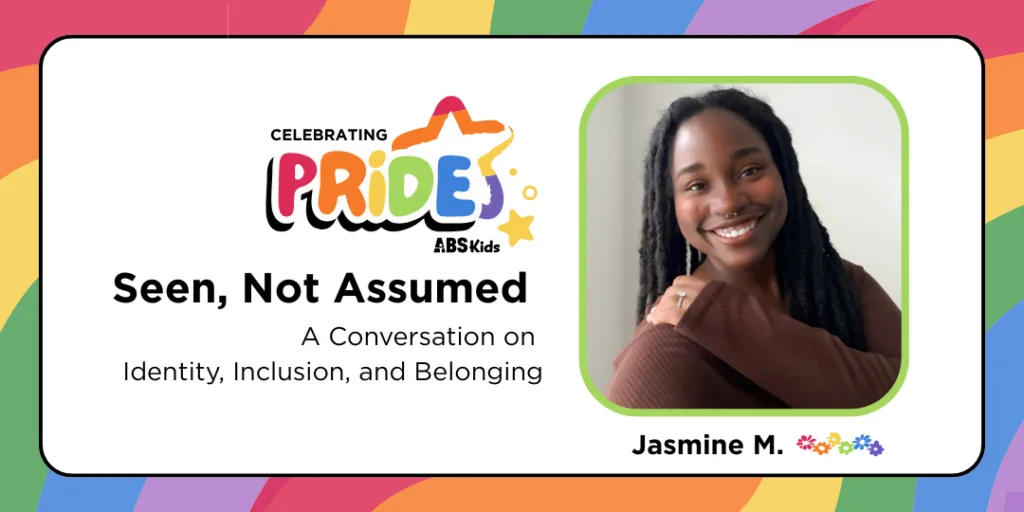
A Pride Month feature with Jasmine M., ABS Kids
In our continued celebration of Pride Month, we asked Jasmine M., a member of our team at ABS Kids, to share her perspective on identity, visibility, and what it means to feel fully seen. Her response is thoughtful, personal, and connects in powerful ways to the work we do every day. We are honored to share it here, in her own words.
On bisexual erasure
“When people assume my bisexuality disappears because of my relationship with my partner, it can feel both isolating and invalidating. I understand that many people make assumptions based on appearances, but those assumptions can unintentionally erase an important part of who I am. Being bisexual should not be defined by the gender of my partner. It is part of my lived experience, my identity, and the way I move through the world.
I think there is a common misconception that bisexuality is only ‘real’ when it is visibly expressed in a certain kind of relationship. What I wish people understood is that identity does not become less authentic because it is not immediately visible to others. Visibility should not be a requirement for validity. Many bisexual people spend a lot of time navigating spaces where they feel ‘not queer enough’ or misunderstood, and that can be emotionally exhausting. Recognition and inclusion matter more than people realize.”
On the connection between bisexual erasure and assumptions about autism
“The connection I drew between bisexual erasure and the assumptions people make about autism comes from a shared pattern of oversimplification. Society often wants identities and experiences to fit into neat, easily recognizable categories. If someone does not match the stereotype people expect, their experiences are questioned or minimized.
With bisexuality, people may assume you are either straight or gay depending on your relationship. With autism, people often assume there is only one way autism should ‘look.’ If someone is verbal, socially engaged, independent, or masking well, their neurodivergence may be dismissed entirely. In both cases, people are reduced to surface-level assumptions rather than being understood as whole individuals with nuanced experiences.
Working in autism services has reinforced for me how important it is to listen to people instead of projecting assumptions onto them. Every person deserves the dignity of defining their own experience. Inclusion starts when we move beyond stereotypes and make room for complexity.”
On how her identities shape her approach to care
“Holding both of those identities as a bisexual Black woman working in autism services has deeply shaped the way I approach care, empathy, and inclusion. Navigating the world as someone with intersecting identities has made me especially aware of how often people feel unseen, misunderstood, or pressured to fit into expectations that were never built with them in mind.
Because of that, I try to approach others with curiosity, compassion, and openness. I think representation and psychological safety matter immensely, especially in spaces centered around care. People deserve environments where they do not have to shrink parts of themselves in order to belong. Whether I am collaborating with coworkers or supporting families, I want people to feel respected for who they are, not who others assume them to be.
I also think intersectionality is important in this work. Families, clients, and staff all come from different cultural backgrounds and lived experiences, and those identities shape how they navigate the world. The more we acknowledge and honor that diversity, the better we can support one another.”
A message to our community
“What I would want LGBTQIA+ staff, clients, and families to know is that they deserve to be fully seen and affirmed exactly as they are. There is no one ‘right’ way to be queer, to be neurodivergent, or to exist in the world. Your identity does not need to be visible to others in order to be valid.
I hope ABS Kids continues building spaces where people feel safe bringing their full selves to the table. Inclusion is not just about representation. It is about creating a culture where people feel respected, heard, and valued without needing to explain or defend who they are.”
Jasmine is a member of the ABS Kids team. Her words are shared here with her permission as part of our Pride Month celebration!

