
Ask most parents what their child is into and you will hear some version of “video games.” Ask which games, and the answer usually stops there.
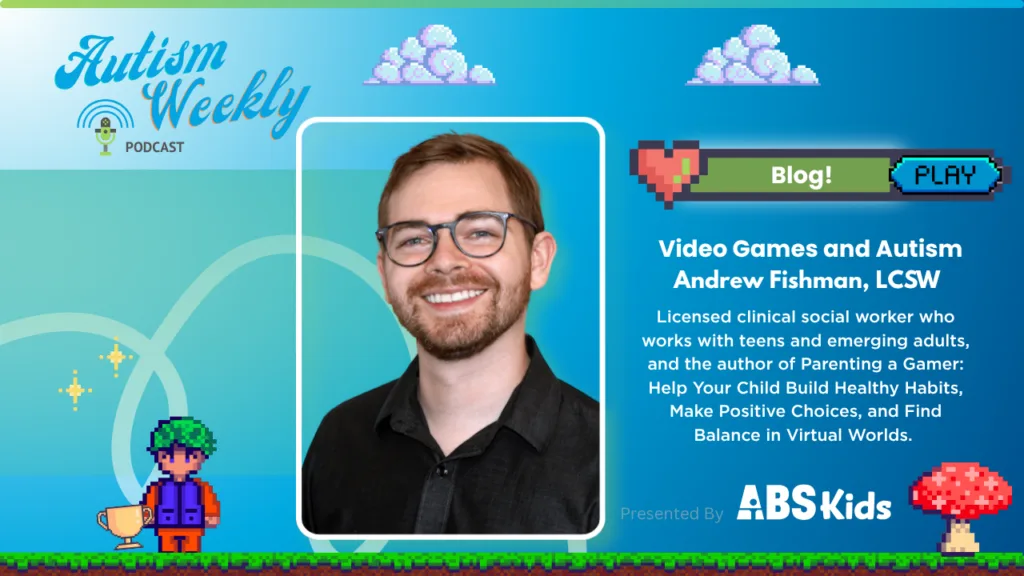
Andrew Fishman, licensed clinical social woker (LCSW), hears that gap every week. He is a therapist who works with teens and emerging adults, a lifelong gamer, and the author of Parenting a Gamer: Help Your Child Build Healthy Habits, Make Positive Choices, and Find Balance in Virtual Worlds. He has led social groups for autistic teens and adults, and he writes about games and mental health for Psychology Today.
On this week’s Autism Weekly, he joined host Jeff Skibitsky to talk about what games provide for kids, why they are so hard to put down, and how families can find balance without the nightly standoff.
Games are not a lesser interest. They are the interest.
Fishman started writing his book after one specific moment kept repeating in his office. He would ask parents about their child’s strengths and interests. They would say video games. He would ask which ones. Very few could name a single title.
A common exchange: the parent says Roblox. He asks which games on Roblox. The parent did not know Roblox held games inside it at all.
That is not a failure of parenting. It is a knowledge gap, and it makes every decision that follows harder. You cannot set a fair limit on something you cannot picture.
Fishman also pushes back on the idea that games are one flat category. Some are mindless. Some, he says, are as emotionally powerful as any book he has read. The range is enormous, and most parents are working from what they have seen on TV.
Why games work so well for autistic kids
This is the part of the conversation worth reading twice.
Fishman describes gaming as “social scaffolding.” In-person interaction asks a lot of a person all at once: hold eye contact, read body language, infer tone, and engage in fair two-way back and forth. Those signals are subtle, and for many autistic kids they are exhausting or unreadable.
Inside a game, most of that falls away.
- Eye contact is not required.
- Scripting works in your favor. A line that lands once will land again with the next group.
- Everyone in the lobby chose to be there. If your child only wants to talk about Minecraft, every other person playing Minecraft also likes Minecraft.
That last point matters. Autistic kids are often coached to broaden their interests to find friends. Games flip it. The interest itself becomes the entry point.
Fishman notes that autistic people log roughly twice as many gaming hours per week as neurotypical people. He does not read that as a warning sign. He reads it as people finding a space where socializing finally costs less.
When to worry, and when not to
Most parents arrive at this topic already braced for bad news, so this is worth stating plainly: for the large majority of kids, gaming never becomes a problem.
Fishman puts estimates for gaming disorder, the true clinical diagnosis, in the single digits. The overwhelming majority of teens play regularly and are fine. He suggests treating it closer to how we treat television than how we treat a crisis.
That said, he gave a clear litmus test. Look at the rest of your child’s life.
- Are they consistently dysregulated after they stop playing?
- Is their social life shrinking?
- Are grades slipping?
- Do they say school or sleep matters, then choose the game anyway because friends are counting on them in it?
The last one is his biggest flag. Not the hours. The conflict between what your child says they value and what they actually choose.
And as Jeff pointed out during the episode, a kid who over-invests in gaming is often the same kid who would over-invest in a sport, an instrument, or a very good book. The skill being built is balance, not abstinence.
The transition fight is not new, and it is not your fault
Stopping a preferred activity can be difficult for any kid, and autistic kids can have additional barriers. It was hard before consoles existed.
Fishman’s first piece of advice to parents is to put down the guilt. If you were parenting better, it would still be a fight. It will probably be a fight for a while.
“Learning to put down that internal struggle and just forgive yourself is crucial.”
Andrew Fishman, LCSW
His second piece is more tactical, and it changes a lot of households. Instead of ending at a clock time, end at a structural break in the game.
He told a story from his own childhood. His brother had an 8:45 bedtime, and his parents kept calling it right as American Idol announced results. Every night ended in “five more minutes.” Once they understood the show’s structure, they gave him the extra five minutes and the argument disappeared.
Games work the same way. Cutting a child off mid-round is not a discipline problem, it is a timing problem.
Two adjustments that work:
- Let them finish the current round or level, then stop.
- Better, move the boundary earlier and change the rule to “do not start a new round after this time” instead of “stop at this time.”
Always turn off public chat.
Fishman is careful about one-size-fits-all advice. Every family is different. This is the one he feels strongly about.
Nearly every game has a communication setting buried in its menus, usually with options like everyone, friends only, friends and teammates, or no one. Fishman recommends turning off the “everyone” option across the board.
His reasoning is blunt. He has never seen public chat go well. It is where slurs, harassment, and hostility live, and players have normalized it. Children do not need that exposure, and autistic kids who are still learning to read intent are especially poorly served by it.
If you do one thing after reading this, do this one. It takes about two minutes per game.
Play alongside your child
This is Fishman’s central recommendation, and it does two jobs at once.
The first is safety. Playing next to your child lets you see who is talking to them. Are these classmates? Are they actually the age they claim? It also closes the Roblox gap from earlier. Sitting down for twenty minutes tells you what your child is actually playing, and whether it fits their age and interests, faster than any amount of research. That kind of passive awareness is far more useful than an interrogation after the fact.
The second job is the relationship, and it is the one he gets most animated about.
You are going to be bad at the game. Your child is going to beat you. Decide in advance that this is funny.
If your child is eleven, you are better than them at nearly everything. Board games end with you either losing on purpose or winning too easily. Neither feels good. Here is one part of their life where they are genuinely, unarguably better than you. Fishman calls that its own gift: it shows a child that it is fine to be new at something, fine to be bad at it, and fine to keep going anyway.
What kids are actually building in there
Skills that transfer, according to Fishman:
- Social experimentation. A low-stakes place to try being funny, or direct, or bold, and to find out how people respond.
- Reading. Some games, like Pokémon, have no voice acting. Every word has to be read.
- Math and probability. Many games are statistics engines wearing a costume.
- Real-world interests. He knows two musicians who picked up an instrument because of Guitar Hero. One is now a professional.
For a child who has rarely felt competent somewhere, that first feeling of making something is not a small thing.
Try this one thing this week
Fishman’s closing advice to parents was a single sentence: stay curious, and do not turn curiosity into surveillance.
So this week, ask your child what their favorite game is. If you do not know, that is the question. Then ask if you can watch, or better, if you can try.
You are not gathering evidence. You are not setting up a trap. Your kids know when they are being judged. You are asking to be let into something they care about, which for most children is a rare and welcome question.
Listen to the full conversation
The full episode with Andrew Fishman is available now on Autism Weekly, wherever you get your podcasts. He also leaves advice for autistic gamers themselves and for providers, including the mistake he sees clinicians make most often: hearing “video games” and letting the conversation stop there.
Parenting a Gamer: Help Your Child Build Healthy Habits, Make Positive Choices, and Find Balance in Virtual Worlds is available from Amazon, Barnes & Noble, Bookshop, and other online retailers.

