

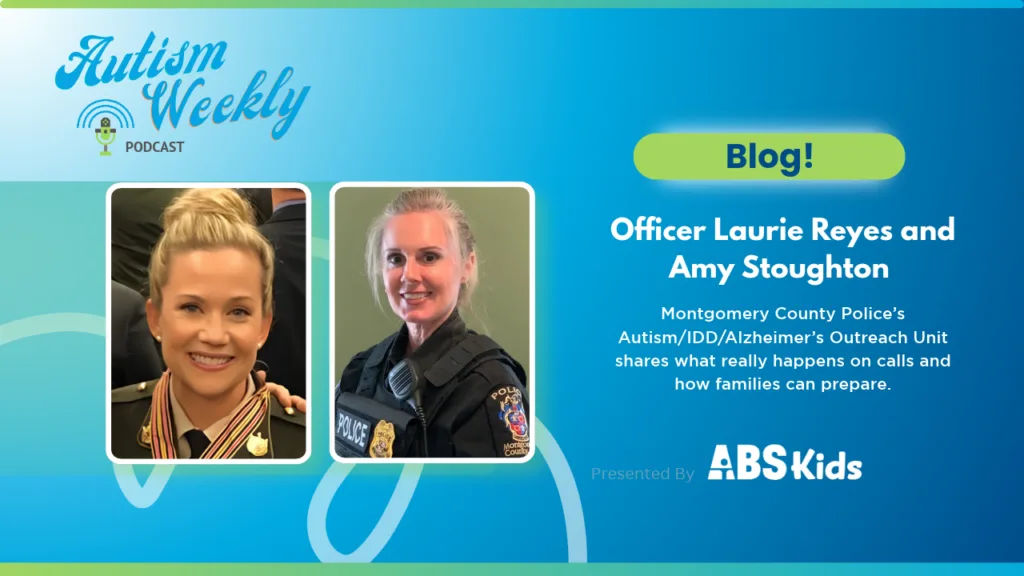
If someone you love goes missing or is in crisis, call 911 right away. That was the clearest message from Officer Laurie Reyes and Amy Stoughton of the Montgomery County Police Department’s Autism, IDD, and Alzheimer’s Outreach Unit, our guests on this week’s Autism Weekly Podcast.
Many families hesitate to call. They worry the officer won’t understand their child, or that police will make things worse. Many autistic people carry that same worry. Those fears are real, and they deserve a real solution.
What one police unit learned in 20 years
Officer Reyes created the unit in 2004 after seeing a rise in calls for wandering and elopement. At the time, there was almost no autism training for officers. So she called families who had been through police encounters and asked what officers did well and what they got wrong. That feedback became the training curriculum.
Today the unit runs on four pillars: training, empowerment, follow-up, and response. A few numbers show the scale of the work:
- 40 to 60 calls a month involving autistic people or people with Intellectual and Developmental Disabilities (IDD), from wandering to crisis
- About 1,000 follow-ups a year with families after an incident
- About 150 proactive presentations a year in schools and communities
- 21 missing-at-risk calls in a single week, which Officer Reyes says is not unusual
The unit has also grown with the people it serves. In 2004, most calls involved children around four or five. Today, many involve teens and adults, which brings new situations and new kinds of risk.
If you are autistic: what to know about police encounters
You do not have to change who you are to be safe. Stimming, looking away, or needing time to answer are not wrong. Trained officers are taught to recognize them. Amy and Officer Reyes teach officers to ask one question first: “Could this be autism?”
If a police officer comes up to you, these steps can help:
- Stay where you are. An officer walking toward you does not mean you are in trouble. Running can make the situation harder for everyone.
- Keep your hands calm and visible. Officers watch hands first. Calm hands help them feel safe, so they can focus on helping you.
- Tell them you are autistic, if you can. You can say it, show a card, or point to a bracelet or shirt. Any way works.
- Say what you need. “I need more time to answer” or “It’s too loud” are clear and helpful.
- Take your time. Amy says some autistic people need about 20 seconds to process a question. Officers in Montgomery County practice sitting in that silence, so they learn not to rush you.
- It is okay to be upset. You can say, “I’m mad” or “I’m scared.” Officer Reyes’ advice is to sit down and listen to the officers, even when you feel that way. They are more likely to listen when you do.
Practice helps. Ask someone you trust to role-play an officer walking up to you, so the real moment feels more familiar.
For parents and families: Eight ways to prepare
- Call 911 right away. Don’t wait to search on your own first. Every minute counts in a wandering case, and officers can start looking immediately.
- Give officers as much detail as you can. Share your loved one’s diagnosis, how they communicate, what calms them, what upsets them, and places they are drawn to, like water or a favorite store. Describe the behavior they are showing right now.
- Write a 911 script. Keep a short card by the phone with name, age, photo, description, communication style, and calming strategies. In a panic, a script means nothing gets left out.
- Don’t count on a registry or tracker alone. Officer Reyes was clear: officers on scene are not pulling up a database. In many cases, police find a missing autistic child before the family knows they are gone. A tracker only helps once you know to look. Layer it with other safeguards, not in place of them.
- Secure your home. Door and window alarms or cameras can alert you the moment someone leaves.
- Use an ID your loved one can carry. A bracelet with emergency contact information helps if a neighbor finds them first. Montgomery County’s safety kit includes a yellow shirt that reads, in part, “I’m a person who has autism, call 911 if I’m alone,” for those who can’t speak for themselves and face immediate danger.
- Rehearse police encounters before they happen. Have a family member play “Officer John” and walk up. Practice the basics: don’t run, keep calm hands, say “I’m a person who has autism” if possible. Social stories work well here.
- Meet your local officers when things are calm. Look for Coffee with a Cop, autism community days, or sensory-friendly events. A friendly first meeting makes a stressful one less scary.
Holidays and Halloween
Halloween and the holidays bring crowds, costumes, noise, and broken routines. That raises the risk of wandering and sensory overload. Plan ahead for teens and young adults heading out on their own for the first time. Ask them: “What would you do if an officer walked up to you? What if a neighbor yelled and called the police?” Talk it through before the night, not during it.
You are not alone
Amy hears from families every week. Her message to all of them: there are many families going through this, and asking for help is the right call.
For clinicians and ABA therapy center teams
Clinicians often see a family’s safety gaps before anyone else does. Here is how to put this episode to work:
- Build community safety into goals. Practicing what to do when approached by an officer, like keeping calm hands, and sharing their autism diagnosis, are skills that can be taught and reinforced over time.
- Use role-play and social stories. Rehearse an officer approach in a calm, familiar setting, at the learner’s pace.
- Help families write their 911 script. Caregivers know their child best, and officers rely on that information. A clinician can help organize it into something easy to read under stress.
- Talk about wandering early. Ask families about door alarms, ID bracelets, and their plan if their child leaves the house. Make sure they know to call 911 first.
- Prepare older learners for independence. Calls now often involve teens and adults. Build these skills before a client starts going out on their own.
- Call 911 without delay if a client goes missing from your center. Follow your center’s elopement procedures, and get officers looking right away.
- Connect families to local resources. In Maryland, the unit works with Pathfinders for Autism. Know the options in your area.
Find support in your community
Not every police department has a unit like Montgomery County’s. You can still find out what yours offers:
- Search your local department’s name with “autism” or “IDD” to find programs, trainings, or community events.
- Ask about autism nights, community days, or Coffee with a Cop.
- Ask your local department for printed safety resources. Montgomery County offers a brochure in several languages.
- Push for change if your area has gaps. Officer Reyes notes that pressure can come from anywhere: your police chief, your local legislators, or your representatives in Congress.
Questions for the unit: [email protected]
Listen to the full episode
Hear the full conversation with Officer Laurie Reyes and Amy Stoughton on Autism Weekly Podcast.

