
Summer is here. The pools are open. The water is calling.
For many autistic children, that pull toward water isn’t a preference. It’s something deeper, something that can feel almost magnetic. And for the families who love them, that draw can be one of the most frightening things about the season.
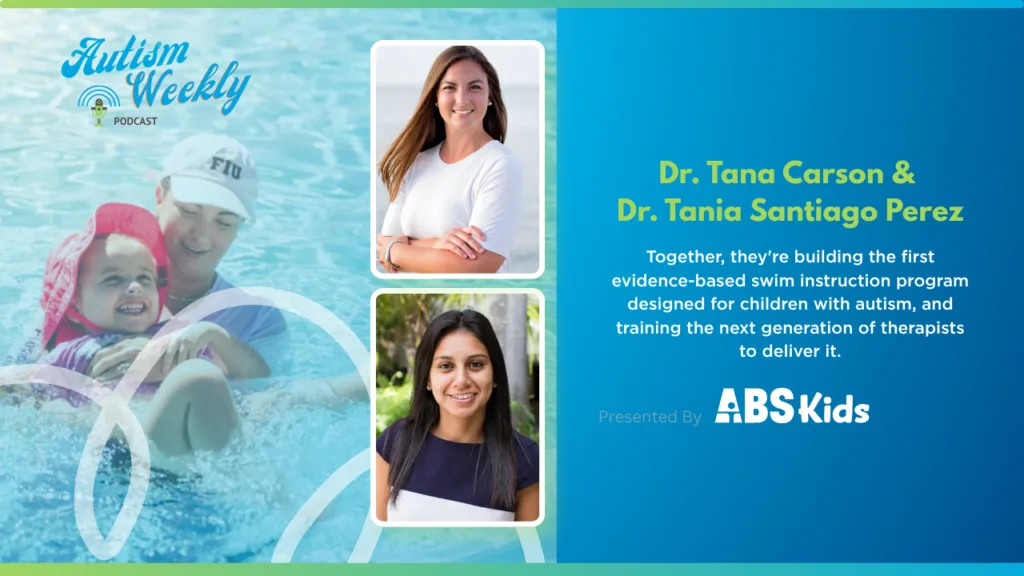
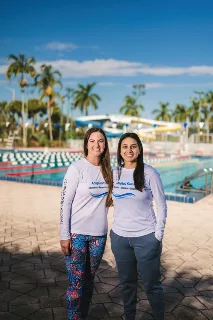
On a recent episode of the Autism Weekly Podcast, host Jeff Skibitsky sat down with Dr. Tana Carson, Assistant Professor of Occupational Therapy, and Dr. Tania Santiago-Perez, Associate Teaching Professor in Recreational Therapy, at Florida International University (FIU). Together, they are building something that didn’t exist before: an evidence-based swim instruction program designed specifically for autistic children, and training a new generation of therapists to deliver it.
Here’s what they want every family to know.
Why Autistic Children Face a Higher Risk
Drowning is the leading cause of accidental death in children ages 1 to 4. For autistic children, the risk is dramatically higher. Research has shown that autistic children may be up to 160 times more likely to drown than their neurotypical peers.
That number demands attention.
Dr. Santiago-Perez explained why the combination of factors is so dangerous. Water is inherently sensory—the movement, the shimmer, the feeling of it. For an autistic child who is seeking sensory input, a pool, a canal, a fountain, or even a puddle can feel irresistible. “The water is providing a sensory need that they have,” she said, “and that’s what draws them to it.”
Add to that the reality that many autistic children elope, meaning they wander or run from safe spaces, often without warning, and the risk compounds quickly.
Then factor in communication differences. A child who cannot call for help, cannot respond to a lifeguard, or cannot express fear is in a uniquely vulnerable position.
And finally, safety awareness. The logic of danger, that a fence is there for a reason, that jumping into a pool fully clothed is not safe, that a canal is not the same as a swimming pool, is something many autistic children are still developing. Jeff recalled a parent training visit years ago where a child was swimming fully clothed, shoes still on, in 50-degree weather, and couldn’t be coaxed out. “This is what we deal with all the time,” the family told him. That moment stayed with him.
It stays with a lot of us.
The Fear That Keeps Families Away from Swim Lessons
One of the most striking things Dr. Carson shared was a conversation with a mother in a clinic hallway. The therapist was inviting families to enroll their children in an adaptive triathlon. The mother said no because of the swimming piece. She said she was too scared even to put her autistic daughter in swim lessons, because she knew the statistics.
“My mind just exploded,” Dr. Carson said. “We’re here working on handwriting and feeding. We have a pool in our gym. And we’re not addressing water safety.”
That fear makes sense. It comes from love. But avoiding water altogether does not eliminate the risk. It may actually increase it, because a child drawn to water but untrained in how to survive it is in the most danger.
Teaching water safety, even basic safety, saves lives.
What Makes Traditional Swim Lessons Fall Short
Standard swim classes were not designed with autistic children in mind. They move in group progressions, everyone learning to blow bubbles at the same time, everyone floating together. That linear structure does not reflect how many autistic children actually learn.
“Sometimes you have to go forward and then three steps backward, then four steps forward again,” Dr. Santiago-Perez said.
What’s different about the approach she and Dr. Carson are developing is that it applies the therapeutic process to swimming. That means a real assessment first, looking at a child’s strengths, sensory needs, communication style, motor development, and behavior patterns. It means individualized goals. It means repetition, visual supports, peer modeling, and fun built into the structure.
It also means focusing on safety skills right alongside swimming skills. Reaching for the wall. Asking permission before getting in. Understanding that a pool and a canal are two very different things.
What You Can Do Right Now
The curriculum Dr. Carson and Dr. Santiago-Perez are building is still in progress. But that doesn’t mean families have to wait.
Here are concrete steps you can take this summer:
- Ask questions when looking for swim programs. When you call a pool, a YMCA, or a community center, ask if any instructors have training in autism or adaptive swim instruction. Ask if there is a certified therapeutic recreation specialist (CTRS) on staff who can assess your child’s readiness and recommend the right type of program, inclusive or one-on-one.
- Ask the providers you already work with. Your child’s ABA therapist, OT, speech therapist, or school team should know that water safety is a concern. Dr. Carson’s vision is that every provider, at every appointment, should be asking about it. You can raise it yourself. Say: Has anyone talked to us about drowning prevention?
- Look into the YMCA. Many families don’t know that YMCA locations offer adaptive programming. The YMCA Swim Buddies program is one example. Call your local branch and ask.
- Start with safety rules before skills. For younger children or those just beginning, the most important things to teach first are: don’t go near water without an adult, AND always ask permission before getting in. Building that habit through consistent routine is lifesaving on its own.
- Explore free resources. Organizations like Autism Society of America and Swim Angelfish have freely available resources for families on water safety. They are a good place to start.
- Don’t wait for the diagnosis appointment. Dr. Carson noted something heartbreaking: many parents can’t remember anything that was said at the appointment where their child received an autism diagnosis, because the moment is so overwhelming. Water safety information handed over in that session often doesn’t land. So if that was your experience, know that it’s not too late. You can start this conversation today.
For Autistic Adults Reading This
If you are autistic and you love the water, that love is valid. Water is one of the most joyful environments on earth. The goal of water safety education is not to take that away. It is to make sure that joy is safe and that you have the skills and the knowledge to be in the water on your own terms.
And if swimming is something you have wanted to learn but the standard lesson environment never worked for you, that is not a failure on your part. The system hasn’t caught up yet. Dr. Carson and Dr. Santiago-Perez are working to change that, and they are not alone.
The Word Both Researchers Came Back To
At the end of the episode, Skibitsky asked each of them what they hoped listeners would walk away with. Both researchers had talked before the recording and independently landed on the same word.
Advocacy.
“You don’t have to be an expert in these things,” Dr. Carson said. “You just have to be interested and supportive and curious and willing to collaborate.”
Advocate for your child. Ask the questions. Push the providers you trust to be part of this. And if you are a provider reading this, consider making water safety part of every intake conversation.
The water isn’t going away. Summer isn’t going away. But with the right preparation, it doesn’t have to be something families face alone.

