
If you are reading this, there is a good chance you have questions. Maybe your child started therapy last week. Maybe you are still deciding whether ABA is right for your family. Maybe you are autistic yourself, and you want to know about the field.
This piece is for all three of you.
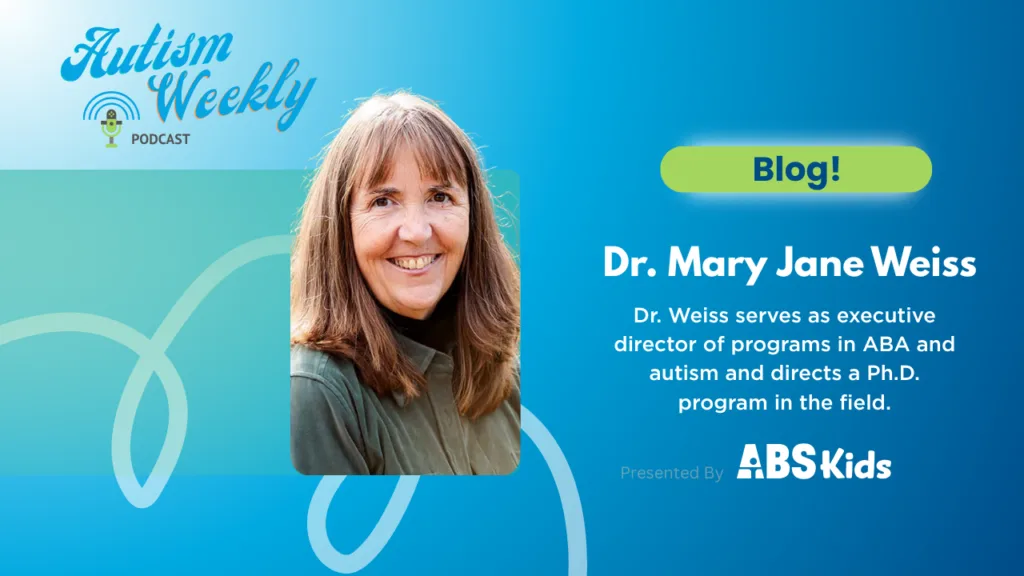
On a recent episode of Autism Weekly, host Jeff Skibitsky sat down with Dr. Mary Jane Weiss, a psychologist and Board Certified Behavior Analyst who has worked in applied behavior analysis (ABA) for close to four decades. She is the Dean of the Institute for Applied Behavioral Science at Endicott College, where she directs the Ph.D. program in ABA. She has spent much of the last several years researching one question in particular: what does compassionate care look like when a clinician is sitting across from you?
Not as a value on a website. As a behavior. As something you can see, feel, and name.
Here is what she had to say.
The field has changed, and that is the point
One of the first things Dr. Weiss said in the conversation was surprising, and she said it plainly.
She began graduate school in 1984. Almost everything she learned about ABA in the 1980s, she said, is now considered antiquated or outright unethical. Skill acquisition looks different. Behavioral intervention looks different. It is, in her words, an entirely different world.
She does not say this defensively. She says it with a kind of relief.
“Hopefully, in 40 years, everything I’m talking about today with you will be antiquated or unethical, because that will mean that the field has done its job.”
Doing its job, in her framing, means evolving as a science. It means being shaped by social movements, by advocacy, by standards of care, by people who pushed back.
For families weighing whether to trust ABA, that context matters. Criticism of this field is real, and much of it has come from autistic self-advocates. Dr. Weiss does not dismiss any of it. She credits it directly. Critiques from neurodivergent voices, she said, helped create the crisis the field needed to respond to and, ultimately, helped it evolve.
So what does compassionate care actually mean?
Dr. Weiss pointed out that if you look up compassion in the dictionary, in nursing literature, in psychology, in behavior analysis, two threads keep showing up.
The first is empathy. Noticing and understanding another person’s experience.
The second is some kind of intentional act meant to improve that person’s circumstances. This is where the standard definitions often go wrong, and she names the problem herself. Many definitions describe this as the alleviation of suffering, language she understands people object to. It assumes the person is suffering. It assumes the clinician has the power to fix it. Both assumptions can be offensive, and she says so directly.
So she reframes it.
BCBAs can maintain awareness of the other person’s experience while reframing the act as a partnership. Can we work alongside the people we serve, toward the goals they identified for themselves?
That reframe changes everything downstream. It means the question is no longer “did this intervention work” as measured by the clinician. It is “what would this person say about it?” What do the caregivers say? What is the real-world difference from their perspective?
She was clear that compassion cannot be reduced to a set of gestures like nodding or saying “I understand.” Compassionate care has to be individually relevant and identified as meaningful by the person receiving it.
When your goal and the clinician’s goal do not match
Jeff asked her about something families run into constantly: What happens when a family, or an autistic person, names a goal that a BCBA does not think is the right clinical priority?
Dr. Weiss did not defend the clinician. She pointed the finger at people in her own role, the ones who train them.
The field, she said, has been strongest at teaching one thing: science is your compass. Use evidence-based practice. Use effective intervention. That is real, and it is in the ethics code, and it is part of what makes ABA a profession rather than a guess.
But clinicians who are genuinely trying to do the right thing can get stuck when the evidence-based option does not align with what a family wants. And what they were often not taught is the rest of the skill set. How to read context. How to identify when to compromise. How to resolve a disagreement in a way that respects the science and protects the relationship.
Her assessment was direct. The field may have overemphasized one half of that skill set and underemphasized the other.
She is optimistic that this is fixable. Interpersonal skills can be taught. They can be operationally defined and measured, and she was emphatic on that point. There is a research literature building around it right now, and she is part of it.
ABA cannot do this alone
Autism is complex and multifaceted, Dr. Weiss said, and behavior analysts do not have all the skills needed to intervene comprehensively.
There are things an occupational therapist is trained in that she has no expertise in. The same is true of speech language pathologists. On matters that fall in their purview, she said, they should be deferred to.
This is not a small statement coming from someone with her credentials.
She noted that ABA was historically siloed. There was not enough communication with the rest of a child’s care team. The 2022 ethics code addresses this more explicitly than any version before it, which she called good news, but she added the same caution she applied to compassion. Valuing collaboration is not the same as being skilled at it. The field is only now beginning to define and teach those skills.
For families, the practical takeaway is this. Good care does not stop at the clinic door. If your child sees a speech therapist, an OT, a pediatrician, a teacher, those people should be talking to each other, and your ABA provider should be part of that conversation rather than passing it off.
Questions to ask when you are choosing a provider
Jeff asked the questions most parents are quietly holding onto: What is the green flag? What is the red flag?
Dr. Weiss started with an honest admission about the moment the field is in. Behavior analysis has many junior members right now. A lot of newly certified clinicians and fewer highly experienced people available to guide them. That makes how you choose more important, not less.
Then she offered questions families can ask out loud.
She was frank about why that last set matters. A provider who has genuinely thought through disagreement will have an answer. One who has not will fumble, and you will hear it. As Jeff put it during the conversation, when someone has not considered it in advance, it does not come out sounding genuine.
You are allowed to ask these questions. You are allowed to ask them at the first meeting.
A word to autistic readers
If you are autistic and reading this, you may have arrived here skeptical, and you are entitled to that.
Dr. Weiss did not ask anyone to set that skepticism down. She named the anti-ABA sentiment in the press and on social media, and she acknowledged that the industry has been plagued with problems, in her words, around “ethical practice.”
What she wanted clinicians to take from the conversation was hope, and specifically hope grounded in the fact that the field is no longer arguing about whether compassionate care, assent-based learning, interprofessional collaboration, and ethical practice matter. The disagreement is over. The work now is advancing them.
That does not undo anyone’s experience. It is not offered as a defense. It is offered as information about where the field is standing right now, which you are entitled to have.
What this means for your family
You do not have to become an expert in behavior analysis to advocate for your child. But there are a few things worth carrying with you.
Your goals count as clinical information. A goal that matters to your family is not a distraction from the real work. It is the real work.
Disagreement is not disloyalty. A good provider expects it and has a process for it.
Your child’s assent matters, and so does your read on how they are doing. If a session is technically effective but your child dreads it, that is data.
Collaboration is a standard, not a favor. Ask your team to talk to each other.
And the person delivering your child’s care should be able to tell you, without scrambling, what they will do when you disagree with them.
The complete episode with Dr. Mary Jane Weiss is available now on the Autism Weekly podcast. Subscribe on your preferred platform to join the Autism Weekly family.

