

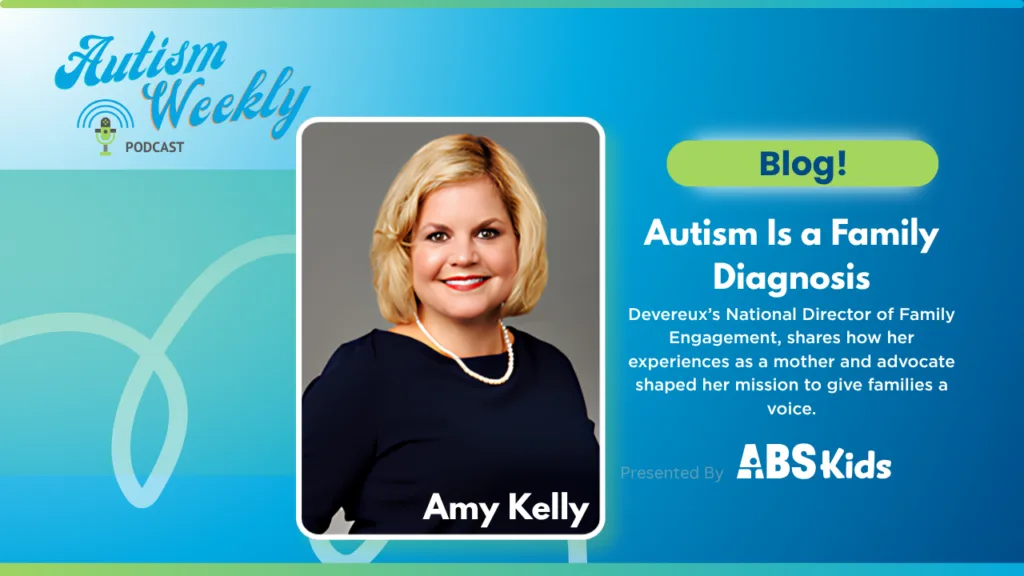
Amy Kelly did not plan a career in autism services. She was a food scientist and a taste tester for Godiva. Then her daughter Annie was diagnosed just before her second birthday, and everything changed.
“That was a job,” Amy says of her old career. “But this is my passion.”
Today Amy is the National Director of Family Engagement at Devereux, a role she noticed a need for and then built from scratch. Devereux Advanced Behavioral Health is one of the oldest and largest nonprofit behavioral health organizations in the country. Founded in 1912, it serves children and adults with autism, intellectual and developmental disabilities, and mental health needs across 13 states.
Amy is also the mother of three young adults: Danny, Annie, and Ryan. Annie is autistic with an intellectual disability and verbal apraxia, which makes speaking difficult. She uses a device to communicate.
On this week’s episode of Autism Weekly, host Jeff Skibitsky sat down with Amy for a conversation about what meaningful inclusion looks like, how families can walk into an IEP meeting with confidence, and the one question almost nobody thinks to ask a parent.
Whether you are a caregiver, a teacher, a clinician, or an autistic adult reading this for yourself, there is something here worth carrying with you.
“They’re on their own timeline”
A missed milestone is often what sends a family to the doctor in the first place. Delayed speech, limited eye contact, a skill that does not arrive when the chart says it should. Those delays can be an early sign of autism. They are not a ceiling.
Annie learned to read and write after she turned 10. Her team was not sure she ever would.
That single fact shapes how Amy talks to every family she meets.
“I would encourage every family out there who is struggling with a minimally speaking or a non-speaking loved one to just don’t give up on them,” she says. “There’s no limit to what they can learn at what age. They don’t stop learning. They’re on their own timeline.”
Annie is now in an adult day program and is still picking up new skills in her twenties. Learning does not stop at 21, and neither does growth.
What real inclusion looks like
Inclusion is a word that gets used often and practiced unevenly. Amy names the difference directly.
“Inclusion isn’t just putting them in the gym for the assembly once a month to say that they were with the other neurotypical children,” she says. “It’s really getting them involved with them. It is them being invited to the birthday parties, even though they’re different.”
She describes what exclusion feels like from a child’s side of the room. “For them, every day is dodgeball and they’re the last kid picked. I think we can all relate to that on some level, of feeling uncertain about where we stand with the rest of the people, or feeling different.”
And she is clear that this applies to every autistic person, at every support level.
“Regardless of your level of autism, if you’re level one, two, or three, Annie being a three, more profound autism, I think it doesn’t matter. Inclusion is important everywhere. And that self-dignity is important everywhere. Respect. All the things that we want for our neurotypical kids are exactly what our autistic kids need.”
That includes choice. Amy points out that self-determination often starts small.
“It could be a little decision. Do you want to wear the blue shirt or the red shirt? But giving them choices is so important, and letting them have decisions.”
How to walk into an IEP meeting with confidence
IEP meetings intimidate almost every family the first several times. Amy has sat through three-hour meetings for 60-page IEPs, and she has practical advice.
Bring a binder, and put your child’s face on it. Gather doctor reports, treatment plans, and any outside speech, OT, or PT reports in one place. Then put a large photo of your child on the cover.
“When you walk into that IEP room, I have held up the binder and said, I just want everybody to remember that we’re talking about Annie today. Often for these teachers it’s IEP meeting after IEP meeting, and kid after kid. You really want to distinguish, this is my child. This isn’t a child. This is my child.”
One page worth adding to that binder: a short profile of your child that anyone on the team can read in two minutes. What they love, what sets them off, how they communicate, what a good day looks like. ABS Kids has a free printable version families can fill out and hand to a new teacher, aide, or bus driver. [LINK: teacher one-pager PDF]
Change the seating. Sitting across from the school team turns a meeting into a standoff.
“I encourage our Devereux staff to make sure that we spread out, so it’s not Devereux on one side of the table and then the family and an advocate on the other. That’s really not partnership.”
Amy has also brought donuts to early morning meetings, simply to thank people for showing up.
Be firm without being aggressive. Amy has little patience for the “difficult parent” label.
“There is no difficult parent. It’s a difficult situation. Just like there is no bad kid. It’s a kid that’s in a bad circumstance.”
Her advice is to be firm and reasonable at the same time, and to back up every request with a reason. Districts are managing funding for every child with needs in the county, and a specific ask lands better than a broad one. “I’m not asking for the world. I’m not asking for everything for Annie. I’m asking for X, Y, Z, because I’m her mom. I know what she needs.”
Bring evidence they can see. When Amy’s family hired a private provider to try a service, they filmed it.
“When we saw progress, we could actually bring it to our county and show them the progress over the course of six months. We’d have little clips, and there was no arguing at that point. It was just very obvious.”
There is a quieter gift in that habit, too. “When you’re living with them day to day, you don’t see all of those little things that they’re doing. But when you view them over the course of time, it’s really so incredible to see that progress.”
The questions families forget to ask
IEPs are templated. Some of the most important supports live outside the template. Amy’s list of things to raise anyway:
- An aide on the school bus. If a child cannot communicate with the driver, the bus is an unsupported gap in the day.
- A communication device that travels. A device at school and a device at home is not enough if it does not ride along in between. “That’s like taping someone’s mouth,” Amy says. As Jeff put it, you have to travel with your voice box.
- Toileting support from a specialist. Annie was 10 when she potty trained, with school staff who wrote the plan alongside her mom. Families rarely think to ask for this help.
- Extended School Year (ESY). Summer breaks can cause regression that is hard to recover from in September. Amy suggests asking about intermittent ESY if a full summer does not fit your family, such as two weeks in June, July, and August.
- A private tutor to make up missed services. If your child missed speech therapy, those minutes are owed.
- Social skills opportunities the school does not offer. If a district says it has no social skills class, come with an alternative. LEGO camps, weekend programs, and online groups can all be written into a plan, and online options can be a gentler entry point for a child with social anxiety.
Amy also names the exhausting part out loud. “You can think about your eight-year-old right now, but you have to think about when they’re 22 and they no longer will be in the school system. That’s the crummy part for our families. We have to think so far ahead in the future.”
Siblings need a plan too
recommends.
The first was inviting her sons into Annie’s home therapy sessions whenever possible. “It made them feel needed. It taught their sister skills. It showed how to interact with another child. And they felt part of Annie’s success.”
The second was Sibshops, a program that connects neurotypical siblings with each other over an activity, a snack, and a trained facilitator who helps them talk about how they feel.
Amy remembers Danny coming out of his first one.
“He said, mom, I met this girl and she has a brother with Down syndrome and they can’t eat in restaurants either. And he felt so validated.”
She connects it straight back to her own experience of finding other parents who understood. “Validation is huge.”
She also protected one-on-one time with each child, including Annie. They called it date time. It did not always go smoothly, and Amy is honest about the grief in that.
“I learned a lot, missing those things that my friends were doing with their daughters. But it’s part of the process of acceptance, and really accepting your child and their diagnosis fully. It takes a long time to get there.”
The question nobody asks parents
Jeff asked Amy what one change she would ask of every school and provider. Her answer was not complicated.
“I would love for them to first start with the parent and say, how are you? How are you doing? And how can we support you? Nobody asks about the parent, how they’re doing. Everything’s focused on the child. And the parents won’t complain about that, because we want it to be about the child. But when people don’t check in with us, we forget about our own mental health and self-care.”
Amy describes carrying guilt any time she did something for herself that was not reading about autism, researching autism, or caring for her kids. Many caregivers will recognize that feeling.
Her framing is worth sitting with: “Autism is a family diagnosis.” The parents and the siblings are part of every stage, every step of the way.
One note for providers. If you ask a family how you can help, be ready to follow through. That means keeping a real resource library on hand, whether it is a specialist referral, a glossary of terminology, or help signing up for Medicaid.
For clinicians and educators
Three principles ran through everything Amy shared:
- Individualize. “We can’t have a cookie cutter plan, treatment plan, or IEP or ISP when they’re over 21. You need to really cater it to each individual and what their needs are.”
- Stay evidence-based. “There’s a lot floating out there right now. If our families stick to evidence-based practices, that’s the way to go, where they can be sure that they are effective and not harmful in any way.”
- Treat the family as an equal team member. Respect them, and include them in every decision.
At Devereux, this is formalized as the Family Standard. “If you as an employee aren’t willing to bring your child to Devereux, then we’re not doing our job right.”
It is a high bar. It is also a useful one for any organization serving families to measure itself against.
Listen to the full episode
Amy Kelly’s conversation with Jeff Skibitsky covers advocacy, inclusion, sibling support, and caregiver wellbeing in far more detail than we can capture here. Listen to the full episode of Autism Weekly on Podbean, Apple Podcasts, or Spotify, and subscribe to join the Autism Weekly family.
If your family is looking for ABA therapy and autism services, ABS Kids supports children and families across North Carolina, South Carolina, Tennessee, California, and Utah. Reach out to our team to learn more.
Frequently asked questions
What should I bring to an IEP meeting?
Bring a binder with your child’s doctor reports, treatment plans, and any outside speech, occupational, or physical therapy reports. Amy Kelly recommends putting a large photo of your child on the front cover to keep the meeting personal. Video clips showing progress at home can also make a request harder to argue with.
How do I advocate without being labeled a difficult parent?
Be firm and reasonable at the same time. Amy’s guidance is that being firm is different from being aggressive. Ask for specific supports rather than everything at once, and explain why your child needs each one. Sitting beside the school team rather than across from them helps set a collaborative tone.
What is ESY and should my child participate?
Extended School Year is instruction provided outside the regular school year for students whose IEPs call for it. Amy encourages families to consider it, because a long break can cause regression that is difficult to make up in the fall. If a full summer does not work, ask about intermittent options.
What are Sibshops?
Sibshops are peer support programs for the siblings of children with disabilities. They combine an activity and a snack with a trained facilitator who helps kids talk about their feelings. Amy credits them with helping her son feel understood by other siblings for the first time.
How can providers better support caregivers?
Ask the parent how they are doing, and then be prepared to help. Amy’s request is simple: start the conversation with the caregiver, and keep a resource library ready so that the offer of support leads somewhere real.
About ABS Kids: ABS Kids partners with children and families to deliver high-quality, compassionate applied behavior analysis (ABA) therapy at home, in schools, and in our centers. From diagnosis to ongoing treatment, we support children with autism every step of the way. We proudly provide ABA therapy in California, North Carolina, South Carolina, Tennessee, and Utah. Join our team to combine purpose with professional growth.

