
If you are raising an autistic child, or you are just beginning to learn what autism means for your family, you have probably heard a lot of conflicting messages. It may help to hear directly from the people studying how the brain actually works, because the science is telling a hopeful and respectful story.
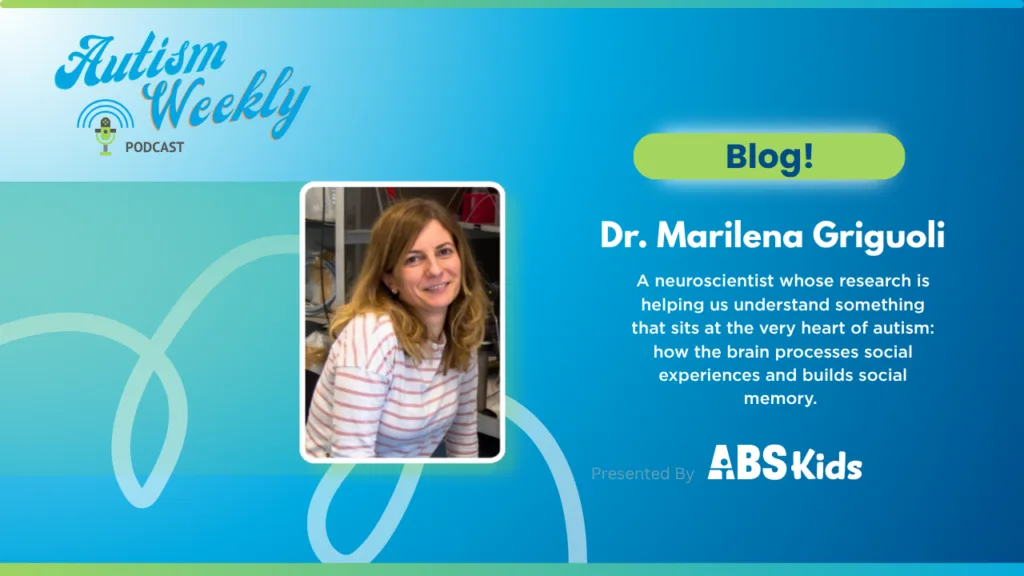
On a recent episode of the Autism Weekly podcast, host Jeff Skibitsky sat down with Dr. Marilena Griguoli, a neuroscientist whose research, funded by the Autism Research Institute, looks at the brain circuits involved in social behavior and memory. Her perspective offers something families can hold onto: a clearer, more compassionate understanding of how autistic brains process the world.
Autism Is a Different Pathway, Not a Broken One
One of the most important takeaways from Dr. Griguoli’s research is also one of the most reassuring. In her words, autism does not need to be corrected or normalized. It needs to be understood. Autism is not a single deficit located in one part of the brain. It is a different developmental pathway.
The goal of good science, she explained, is not to make an autistic person think or behave like everyone else. It is to understand how their brain works so we can support communication, learning, social connection, and overall well-being.
For parents, this reframing matters. Your child is not a problem to be fixed. Their brain is developing along its own route, and the work of science, therapy, and family support is to understand that route and walk it alongside them.
The Science of Social Memory
Much of Dr. Griguoli’s research focuses on something called social memory. In simple terms, social memory is the ability to recognize and tell the difference between someone you have met before and someone new.
Studies have shown that some autistic children experience this differently, including how they recognize familiar faces. Dr. Griguoli’s work digs into the specific brain cells and connections involved in this process, and what may be different in autistic development.
The brain is built from neurons, the cells that carry information. These neurons organize into circuits, networks that communicate with one another to shape behavior. These circuits are not tucked into one neat corner of the brain. They stretch and overlap across many regions. In autism, some of these circuits, especially those tied to social behavior, communication, and coordination, appear to develop differently.
Understanding how those circuits form during early development is at the heart of her research, and it could one day inform more precise, patient-centered ways to support autistic individuals.
A Major Shift in How Scientists Think About Connection
The old assumption that autistic people simply lack interest in social connection has changed, and may just be one of the more meaningful shifts.
Dr. Griguoli was direct about it: “Autistic people are actually interested in engaging in interaction,” she said. “It’s just the way they process and perceive social interaction that’s different from what we think of as typical. It’s just different.” The work now, she added, is to try to enter that world and find a common way to connect.
This shift carries real weight. It moves the conversation away from what an autistic person is missing and toward how we can better understand and meet them.
For anyone who is autistic and reading this, that message is worth repeating: your way of connecting is not a failure of connection. It is its own valid way of being in the world.
What This Could Mean for the Future
Dr. Griguoli is careful and honest about timelines, which is part of what makes her work trustworthy. She studies the cholinergic system, a network of neurons that release a chemical messenger called acetylcholine and send signals across regions of the brain tied to social interaction and memory.
In her lab, she has found that these particular neurons appear more vulnerable in some genetic backgrounds linked to autism, not tied to any single diagnosis. That early finding opens questions worth exploring, including whether supporting these circuits during the early phases of development could make a difference over time. She is clear that this is early, preliminary science, still unpublished, that still needs to be repeated and confirmed across many genetic backgrounds before it could ever shape treatment.
That honesty is a feature, not a limitation. Solid basic science takes time, and the careful, patient work happening now is what makes meaningful progress possible later. For families, the long-term promise is a more personalized understanding of autism, which varies widely from one child to the next and even within the same child across different stages of growth.
How Families Can Stay Informed Without Getting Overwhelmed
Dr. Griguoli also offered practical guidance for families who want to learn more, which is especially useful when so much information online can be confusing or misleading.
She suggested looking for review or perspective articles in scientific journals, which summarize findings in clearer language than dense original studies. She also recommended following trusted sources such as universities and established autism research institutions, which tend to communicate their work in plain, accessible language. Podcasts like Autism Weekly and researchers who are skilled communicators are another good entry point.
Her one caution: be careful with sensational headlines. Regular news coverage sometimes overstates or oversimplifies findings, especially around claims of a “miracle” therapy. When in doubt, lean toward the science and reputable sources.
The Message She Wanted Families to Hear
When asked what she most wanted families to take away, Dr. Griguoli returned to where she started. She repeated that autism is not a deficit in a single region of the brain; it is a different developmental pathway, and it does not need to be erased.
The goal, she said, is to understand how that pathway works and to support communication, learning, social connection, and well-being in ways that help an autistic person thrive as themselves.
That is a hopeful note to end on. The science is moving forward with care, curiosity, and respect. And underneath all of the research is a simple, steady truth that every family deserves to hear: understanding comes before everything else, and your child is worth understanding fully, exactly as they are.

